|
California State Parks & Beaches
California state parks and beaches are known the world over for their scenic beauty and temperate climate. Some of California's finest outdoor activities are located in or near Newport Beach and offer visitors an extensive list of activities and adventures.
Newport Municipal Beach
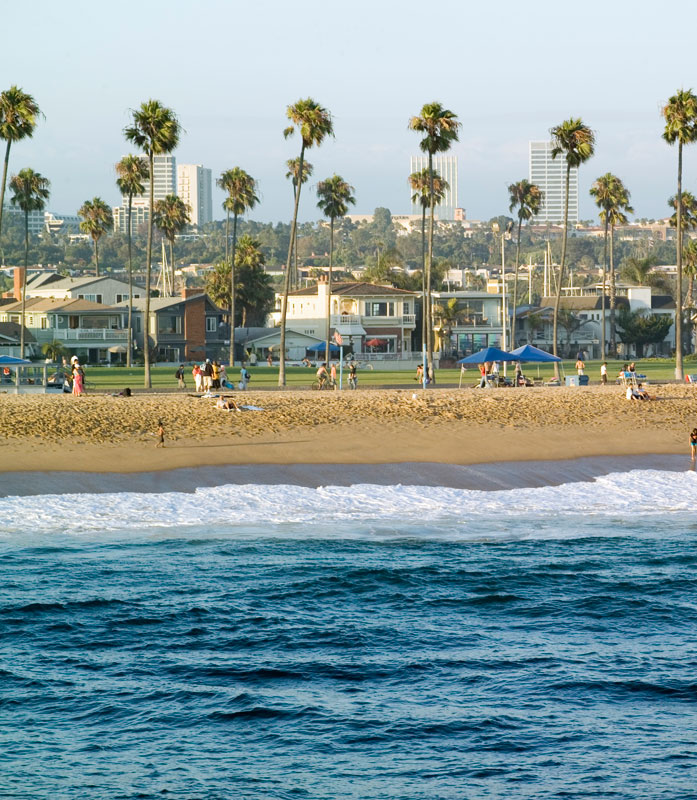
On Balboa Blvd., at Oceanfront and 21st Street. Newport Beach offers fine, soft sand with plenty of room to stretch out and enjoy yourself. Surfers, swimmers and sunbathers all bask in the warmth of beautiful Southern California winter and summer days. Pelicans and seagulls also enjoy Southern California's year round Mediterranean climate.
Near the base of the Newport Pier is the Dory Fishing Fleet, founded in 1891. The pier offers stunning views to the north toward Huntington Beach, and looking south, you can see another structure, the Balboa Pier. This five-mile stretch of beach boasts a bevy of activities. Swimmers and sunbathers flock to the beach in summer and winter, capping off their day in the sun with a night of casual or fine dining. Skate, bike and board rentals are popular, and surfing off the jetty is prime. The vibe at Newport Beach is youthful and fun.
The summer is the best time to visit Newport Beach. The beach crowd is relatively small because the peninsula is located somewhat off the beaten track. So you can enjoy the summer sunshine and the long sandy beach, without the typical Southern California beach traffic.
This is an ideal place for cycling and skating, but keep in mind that parking is limited and you might have to walk a few blocks to get to the sand. Newport Beach has a lengthy bike trail, which extends around most of the peninsula. Riding along the boardwalk is fun and a great way to check out some of the most expensive real estate in Southern California. Many of the houses on the boardwalk are summer rentals, so if you have the extra cash it is a nice way to experience living life on the beach. There are also a few quaint boutique hotels in near the beach, for more information go to http://www.visitnewportbeach.com/staying.asp.
Hours: Open 6 a.m. to 10 p.m.
Parking: $1/hour metered spaces next to the pier and in the surrounding streets; limited free street parking across Balboa Blvd.
Facilities: Lifeguard, restrooms, fishing, surfing, picnic tables, fire pits
Insiders Tip: Check out www.surfline.com for up-to-date information on weather and surf conditions.
go to top
Balboa Pier/Balboa Beach
Location: At the end of Balboa Blvd., west of Main St. The Balboa Pier and beach are accessible from the Pacific Coast Highway (PCH) or you can take the more adventurous route by cutting across Balboa Island and taking the ferry over. The fare is only 60 cents per person one way and $1.50 per car.
Balboa Peninsula is part of the city of Newport. It is a hip and cool beach town with trendy cafes and an ample amount of surf shops. There are rental stores along many of the side streets which offer: rollerblades, beach cruisers, tandem bikes and surfboards. The beach offers a small-scale surf break for tourists and children. It is rarely surf-able, but is a fun and mellow place to try out surfing for the first time.
Don't miss out on The Fun Zone; a famous amusement park attraction on the Balboa Peninsula. It is pretty hard to miss the bright lights of the Ferris wheel and the strong smells of popcorn and cotton candy. The shops and dining make for great fun for families and others of all ages. Bike and skate rentals are widely available, but neither is permitted on the boardwalk of the Fun Zone. The Newport Harbor Nautical Museum is in the midst of relocating to the Fun Zone, so be sure to check out their progress by visiting the Preview Center. www.nhnm.org
Parking: Metered street parking.
Hours: Open 6 a.m. to 10 p.m.
Facilities: Lifeguard, restrooms, showers, fire pits, fishing, surfing, picnic tables, BBQ grills
Insiders Tip: In the summer, the beach around the pier can be almost overrun by kids taking swimming classes. Head a little further north to avoid them.
go to top
The Newport Wedge
Located at the very end of the Balboa Peninsula, the Wedge is a famous surf spot with large surf breaks close to shore. Every summer, swells that begin life off New Zealand, half a world away, finally slam home in North America at the tip of this famous breakwater. As the waves approach shore, they bounce off the jetty's boulders and, in the final seconds before landfall, merge and morph into a backbreaking and monstrous wave known as the Newport Wedge.
The Wedge is an elusive wave that breaks only a few times a year-it peaks during the summer months-and because of its unpredictability, it's no place for a board. Because of this, it remains a site for wave riding in its purest form- bodysurfing. The Wedge breaks so hard, in such shallow water, that even highly skilled bodysurfers sometimes get seriously injured, proving that this is not a wave to be taken lightly.
Unlike Oahu's Banzai Pipeline, Northern California's Maverick's, or any other world-class big break, the Newport Wedge has the unusual distinction of being entirely man-made. Built in 1918 to protect the harbor, the jetty creates a wave effect unlike any other. Here's how it works: Grinding alongside the boulders and headed for shore, each wave generates a reflected wave that bounces off the jetty and moves sideways behind the original. When that "side wave" hits the next incoming wave, the two combine to form a double-size mutant triangle. Precisely where the waves converge, the ocean floor rises abruptly. The big peak has no place to go but up.
Parking: Limited street parking.
Facilities: Lifeguards, bodysurfing
go to top
Newport Beach Back Bay/Newport Beach Ecological Reserve
Upper Newport Bay in Newport Beach is an estuary - a place where fresh and saltwater meet and mix. It is one of only a few remaining estuaries in Southern California and is the home of nearly 200 species of birds, including several endangered species, as well as numerous species of mammals, fish, other critters and native plants.
The Bay is an important stopover for migrating birds on the Pacific Flyway and up to 30,000 birds can be seen here on any day during the winter months. Its close proximity to the 73 Freeway makes Upper Newport Bay easily accessible to residents of Orange County and beyond. Many people come here to hike, cycle, canoe, kayak, fish or simply enjoy nature.
Three sensitive species use the bluffs: The California Gnatcatcher, San Diego Cactus Wren, and Burrowing Owl. Two important plant communities are found on the bluffs - grasslands and coastal sage scrub.
Upper Newport Ecological Reserve totals 752 acres. This coastal wetland, one of the largest in southern California, is renowned as one of the finest bird watching sites in North America. It is home to six rare or endangered species: Light Footed Clapper Rail, Brown Pelican, Belding's Savannah Sparrow, Black Rail, Peregrine Falcon and California Least Tern. The Bay is home to one endangered plant species - Saltmarsh Bird's Beak. Considered a "critical estuary" habitat - Upper Newport Bay is one of the most pristine remaining estuaries in Southern California.
Nature Walks
Nature walks usually take place on the 1st and/or 3rd Saturday of the month. Join a Naturalist at Shellmaker Island at 9 a.m. for an introduction to the Bay, then car pool over to the Big Canyon for a walk that takes you through several habitats and gives you an opportunity to experience the diversity of plants and wildlife at the Bay. Bring sun protection and binoculars if you have them. No reservations required. This tour is free. Please call (949) 923- 2269 for more information.
Friends Tours (October - March)
Tours take place every 2nd Saturday of the month, October through March. Observe the birds on Tern Island from the lookout at the corner of Eastbluff and Back Bay Drive. Then join a naturalist who will escort you between outdoor "classrooms" set up along Back Bay Drive, where you will learn about different aspects of the Bay, its history and ecology. Tours depart from the lookout every 15 minutes from 9:00 until 10:15 a.m. Here you should also bring sun protection and binoculars if you have them. No reservations required. This tour is also free. Please call (949) 923- 2269 for more information.
For updated information on tours of the Newport Beach Back Bay and Newport Beach Ecological Reserve, visit www.newportbay.org.
go to top
Crystal Cove State Park
Location: On the north side of Laguna Beach, at the end of Crescent Bay Drive.
Crystal Cove State Park has 3.5 miles of beach and 2,000 acres of undeveloped woodland, which is popular for hiking and horseback riding. The offshore waters are designated as an underwater park. Crystal Cove is frequented by people who enjoy water related activities, such as swimming, surfing, sunbathing, scuba and skin diving, as well as people who like to fish, mountain bike and hike.
Hikers can follow hillside and canyon trails north and east of Pacific Coast Highway to campsites, allowing visitors to feel they are "away from it all," despite being near one of the greatest population centers in the United States.
http://www.crystalcovestatepark.com/
Camping: Please keep in mind that this is not beach camping. After you park your car in El Moro lot, you must hike inland about three miles, mostly uphill. The trail is strenuous at times and is in the opposite direction from the beach. Some people report that it takes two hours to reach the campgrounds, one way, while others report six hours. You must pack everything in, including water.
There are three different campgrounds with 34 campsites/ 4 persons per site.
Call (949) 494-3539 for further information (including camping fees). To make reservations, please contact Reserve America at 1-800-444-PARK.
Beach Access is available at these points:
Reef Point - A popular beach access is from Reef Point parking lot. There are three access points to the beach. A quarter mile multi-use trail travels to the north and descends down to the beach at 3.5 Cove. A stairway delivers you to the popular Scotchman's Cove and to the south, a ramp travels down to Muddy Creek, an excellent body surfing area. No camping available.
Pelican Point - There are four bluff top parking lots, with access points to the beach. Next to each parking lot, there are restroom facilities with outdoor showers. A one mile multi-use trail parallels the coast line that offers a view of the coastal bluff vegetation and wildlife. No camping available.
Los Trancos - This parking lot is available for access to the Historic District. There is a tunnel under Pacific Coast Highway to view the Crystal Cove Cottages, as well as a pedestrian crosswalk at the Los Trancos signal light. No camping available.
Parking: Parking is plentiful with 3 parking lots on the Pacific Coast Hwy between Corona Del Mar and Laguna Beach. No camping available.
Hours: Open 6 a.m. to 10 p.m.
Facilities: Lifeguards, access for disabled, restrooms, fishing, surfing
Insiders Tip: Dogs are not allowed in the park or on the beaches! Dogs on leashes may walk on the paved pathway above the beach.
go to top
Crystal Cove Cottages
Location: Between Laguna Beach and Corona del Mar, in the heart of Crystal Cove State Park. Take Pacific Coast Highway to the Historic District entrance on Los Trancos.
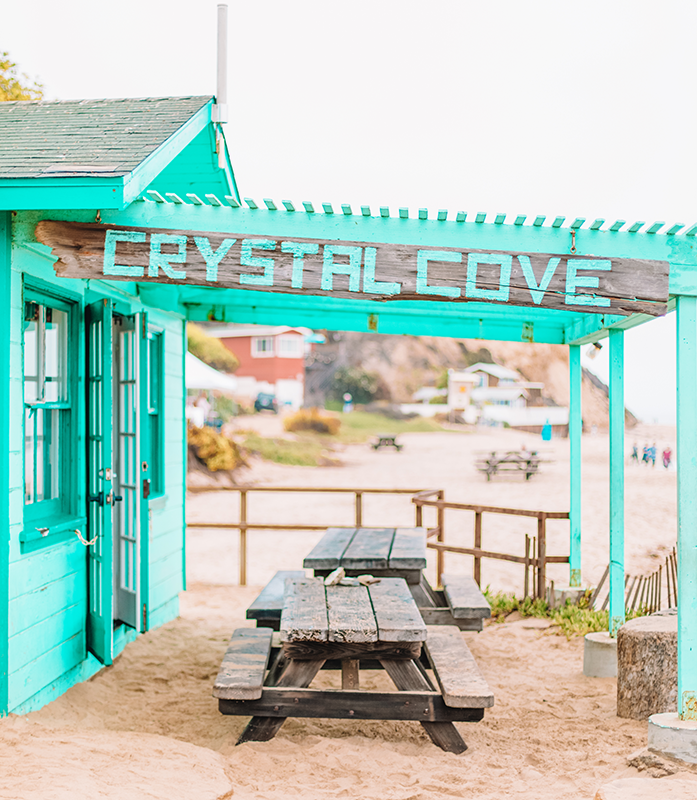
Take a step back in time with a visit to the newly restored Crystal Cove Beach Cottages in the Crystal Cove State Park Historic District! Whether in an Individual or Dorm-style Cottage, Crystal Cove Beach Cottages offer gorgeous ocean views, charming historic details and a glimpse of a uniquely Southern Californian beach community from a bygone era.
The Historic District was first developed as a South Seas movie set due to its seclusion and tropical aura. The community thrived and became beloved for its relaxed, friendly atmosphere and picturesque landscape, and in 1979, the Crystal Cove Historic District was placed on the National Register of Historic Places.
We invite you to experience the magic of Crystal Cove as it existed from the 1930s to 1950s with a stay in one of 11 Individual or 3 Dorm-style Cottages. Located directly on the beach or overlooking it from a bluff top, each cottage has been painstakingly restored and furnished to recreate Crystal Cove's unique historic beach culture and ambience.
There is a full-service restaurant, The Beachcomber Café, which operates a shuttle from the Los Trancos parking lot to the visitor drop-off area in the heart of the Historic District. The shuttle operates when the restaurant is open. The restaurant is open for breakfast (7:30 - 11:30 a.m.), lunch (11:30 a.m. - 4:30 p.m.) and dinner (4:30 - 9:30 p.m.). A nominal fee is charged each way, but all visitors are welcome to use the shuttle. The Beachcomber is a popular 1930's style restaurant with indoor and outdoor seating. For more information call (949) 376-6900 or go to www.thebeachcombercafe.com.
Rental Info: Reservations are available year-round. More rentals become available on the 1st of every month. To make a reservation, please call (800) 444 - 7275 or go online to www.reserveamerica.com.
Parking: Off Pacific Coast Highway, go East on Los Trancos into the parking lot. The Historic District is a 10 minute walk from the Los Trancos lot. To reach the cottages by foot, use the pedestrian tunnel behind the public restrooms, which will take you under Pacific Coast Highway, or, if the tunnel has rainwater in it, walk back to the lot entrance on Pacific Coast Highway and use the crosswalk at the traffic signal. Parking validation is available for customers who dine at The Beachcomber restaurant. Otherwise, it is $10 daily. Exact change for parking is appreciated.
Insiders Tip: The Beachcomber Café, during the 1930s - 1950s was known for its laid-back party atmosphere, and now continues that tradition with a salute to the martini flag every Saturday at 4 p.m. Their motto: "Every night is Saturday night, and every Saturday night is New Year's Eve."
http://www.crystalcovebeachcottages.org
go to top
Corona Del Mar State Beach
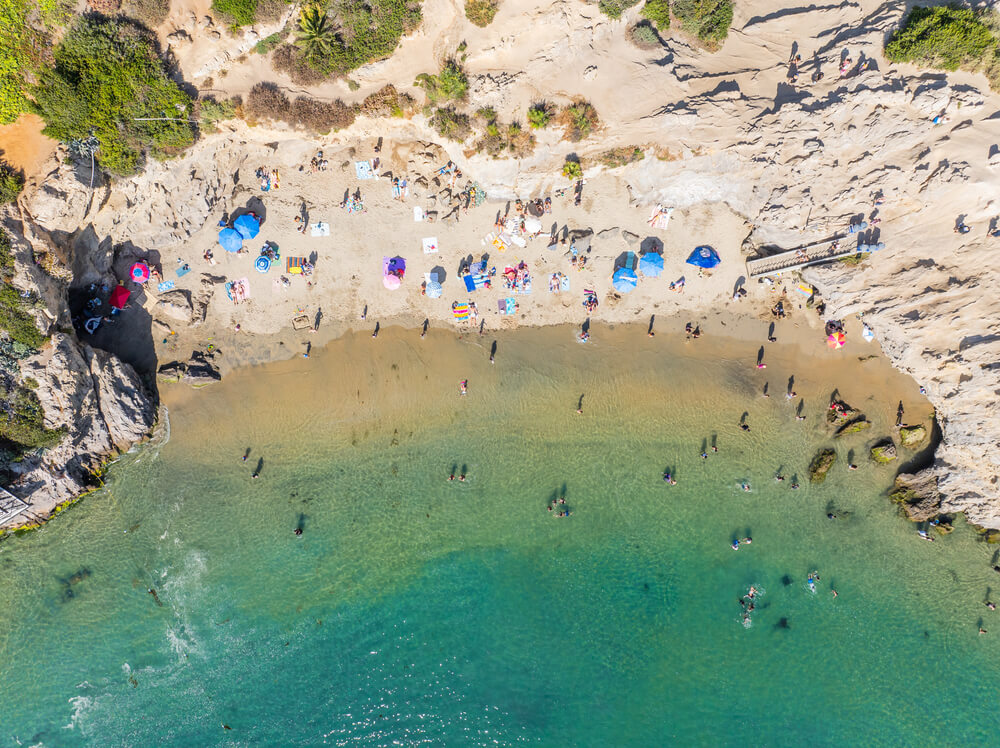
Corona del Mar State Beach is a great family beach and a popular place for swimmers. Also known as "Big Corona Beach", this is a half-mile long sandy beach framed by cliffs and a rock jetty that forms the east entrance to Newport Harbor. The beach is also popular with surfers, divers, volleyball players and sunbathers.
Corona del Mar offers beautiful sandy beaches and coves that look like they came right off of a movie set. You actually may have seen these beaches in movie and television productions such as Gilligan's Island and current "made for TV" productions from Disney. On the hills above the beaches stand houses and windy roads and a lookout point to enjoy spectacular views of the Pacific Ocean and bay. The sunsets here are incredible, so bring a picnic and enjoy!
Corona del Mar held the first major surf competition in Mainland America: the Pacific Coast Surf Riding Championships in 1928. Organized by Tom Blake through the Surfboard Club, the contest involved paddling and surfing skills. From 1934 to 1936, in order to make the entrance navigable for boaters, the harbor entrance was dredged to 25 feet and over 200,000 tons of rocks were dropped at the entrance to extend the West and East Jetties. The East Jetty grew to its current 1,673 feet and, along with the removal of the entrance sand bar, killed the easy waves that had become so popular.
Location: Take Pacific Coast Highway to Marguerite Ave. and head west toward the ocean. Parking is on the right at Ocean Avenue.
Parking: Entrance fee per vehicle (Approx. $8). Lot fills up fast!
Hours: Open 8 a.m. to 8 p.m.
Facilities: Lifeguards, access for disabled, rest rooms, fire pits, fishing, surfing, showers, picnic tables
Insiders Tip: Unless a huge south swell is running, forming "foamers" off Newport Harbor's East Jetty, no stand-up surf exists. Bodysurfers and bodyboarders rule this beach.
go to top
Little Corona del Mar Beach
From Pacific Coast Highway, turn south on Poppy Avenue, a very narrow road that leads to a cliff above the ocean. This is where you can go down a paved path to the beach. The road here abruptly turns right into Ocean Blvd which leads to Big Corona. This vantage point offers one of the most breathtaking views of the ocean. To the right, you can see the beach of Big Corona and the mouth of Newport Harbor and to the left, a long stretch of rocky cliffs starting with Little Corona. On a clear day you can clearly see Catalina Island some 25 miles away.
The path to Little Corona is one of very few in Orange County that does not involve stair steps. One can wheel equipment right down to the beach and this alone makes Little Corona a desirable spot for divers and picnickers alike. This site also has a public restroom and shower facility that is open during the summer months. The walk down a steep hill and street parking only makes access for the disabled a problem. The seclusion and tide pool are highlights here and the visitors are predominantly locals.
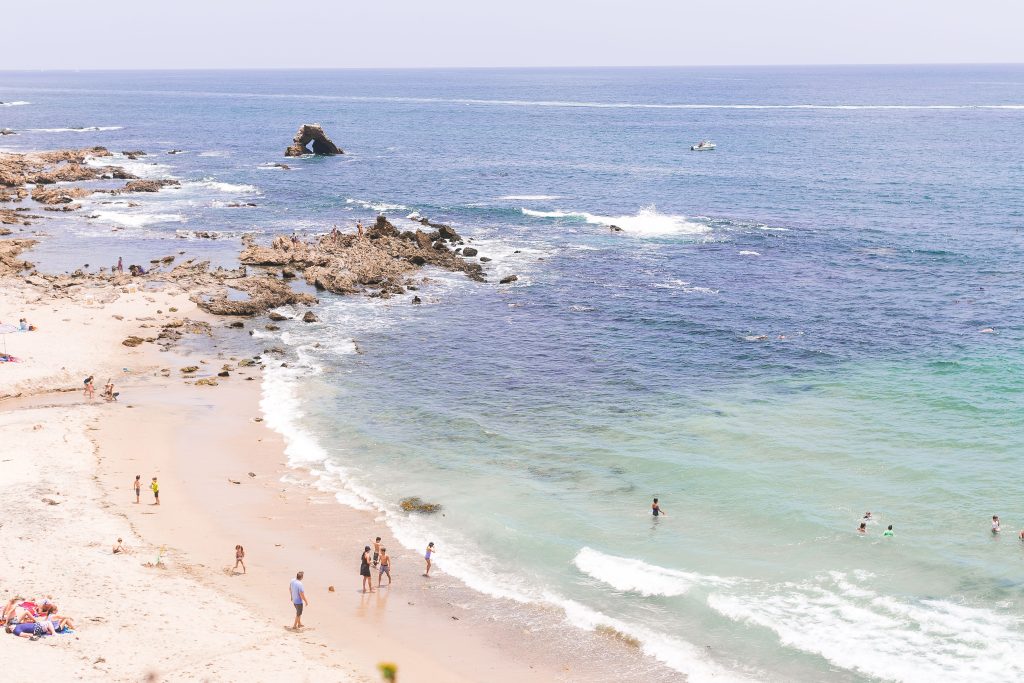
The beach is relatively small, flanked on both sides with rocky reefs that offer the spectacular diving well known to local divers. The beach is very well protected from swells and surf, making it one of the easier beach diving sites and a great beach for families who don't want to worry about their little ones getting towed away by a large wave or undercurrent. Beyond the water edge, the sandy beach drops off to scattered rocks hidden among eel grass making Little Corona an excellent snorkeling site. There are several buoys about 150 yards out marking the boundary where boats and jet skis cannot enter.
Parking: Limited street parking in surrounding neighborhoods.
Hours: Open 6 a.m. to 10 p.m.
Facilities: Lifeguard, access for disabled, portable restrooms, fishing,
Insiders Tip: There are no snack bars or food vendors at this beach, so make sure you pack a sack lunch or bring something to snack on.
go to top
Visit the California State Parks website for more information on California State Parks and Beaches http://www.parks.ca.gov/
|